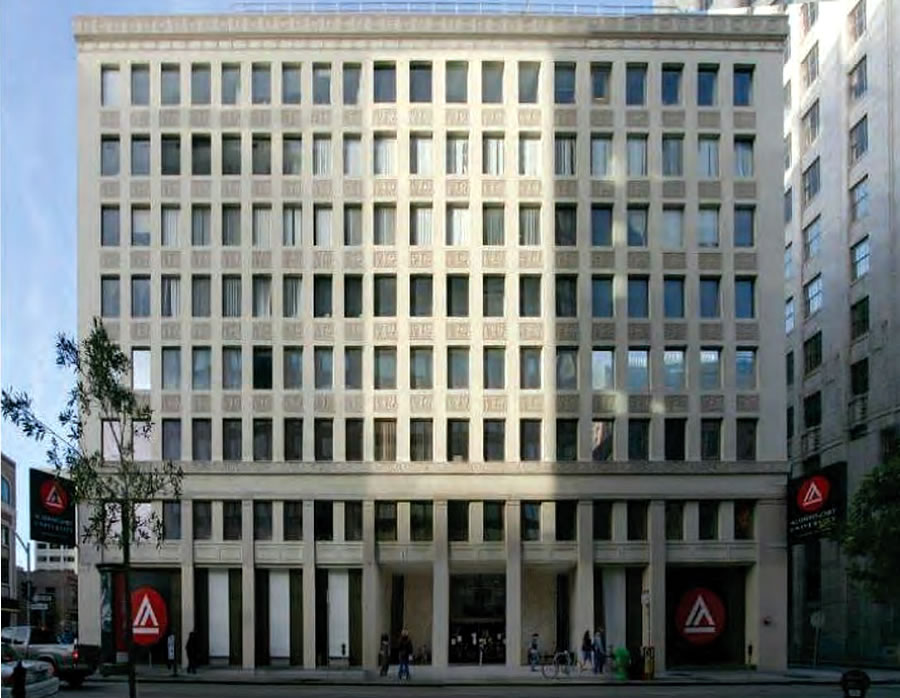
While the original terms of the Academy of Art University’s nearly $60 million settlement with the City of San Francisco – to resolve allegations that the institution had systematically schemed to violate state and local laws in its acquisition and use of real estate holdings in San Francisco over the years – have changed since the tentative deal was reached back in 2016, the size of the settlement has not.
In addition to $7 million in penalty payments and in excess of $3.5 million in fees, the Academy will now make an $8.2 million payment to the to San Francisco’s Small Sites Fund and an additional $37.6 million cash payment to the City, to be used solely for affordable housing purposes, “with a first priority for uses related to the creation or preservation of single room occupancy (SRO) units in those supervisorial districts in which the City alleges the Academy unlawfully converted SRO buildings to student housing,” rather than providing any subsidized housing themselves, for total payments in excess of $58 million.
The Academy has also agreed to meet all future housing needs for its student body through the permitted construction of new units on property that is legally zoned for such a use or through the conversion of existing “non-residential, non-PDR” structures (and “to not promise new students more housing units than the number of lawful units that are at its disposal” nor temporarily house students in non-Academy facilities, with a few exceptions).
The Academy will also vacate and cease all Academy related operations at the following nine (9) properties:
150 Hayes Street
168 Bluxome Street
460 Townsend Street
700 Montgomery Street
1055 Pine Street
1069 Pine Street
2295 Taylor Street
2340 Stockton Street
121 Wisconsin Street
And if approved by Planning this week, the remaining thirty-four (34) properties which the Academy owns throughout the city will be brought up to code, legally permitted and authorized for Academy use, including the three buildings at 1142, 1946 and 2550 Van Ness Avenue which aren’t currently being used by the student body.
The settlement should be for more money. Many violations occurred in the purchase and build-out of student housing and in the school’s recruiting process.
Many promises were made by Richard A. Stephens during my 7+ year tenure. An out of court settlement was for a small annuity.
I agree. Is there any entity in San Francisco which has removed more affordable housing than the Academy of Art? It’s easy to point out a greedy landlord here or there, but the Academy of Art did the same thing on an industrial scale. This is small change to them.
I agree, they are getting off way too easily. Money talks, and they have a lot of it. It shouldn’t be that way.
AAU is responsible for taking far more housing off the market than this settlement will ever create to replace it.
it says a lot about the folks in San Francisco government that this situation was allowed for many years. Poor governance!
Is there a list somewhere of which SF elected officials have received their donations over that years? It would make interesting reading, to compare that list with people who claim they support affordable housing.
I give Herrera credit for going after them. Like you said, this has gone on for decades and no one else said anything.
Willie Brown for one
Oh, obviously Willie Brown. But he’s not alone. Ed Lee, Jane Kim, etc. etc. I don’t know if a list exists, but it would make for interesting reading if it did.
Of course, it was great business for the Academy of Art. The money they made was much larger than whatever their contributions were, and this “penalty” is a pittance.
“The Academy will also vacate and cease all Academy related operations…” does that mean those buildings will become affordable housing? Are they selling them off or giving them to the city? If not providing rent-controlled units again, it does seem like the $58 mil is chump change. That wouldn’t cover a single new affordable building, nothing near the many buildings they removed from the market.
If you look the properties up on google maps, it’s just a collection of warehouses. One of them is a parking lot they have used for their shuttle buses. Another just looks like a portable classroom. Presumably as well these sites could eventually be built out- vacate is not the same as forfeit. Plus the other sites they now have permission to start using on Van Ness more than make up the space. So this means nothing.
700 Montgomery is an office building in North Beach. 1055 Pine Street is a residential building that was used for student housing and the city plans to have developed into senior affordable housing (it was formerly a nursing home if the elderly). 1069 Pine is a small building used as a gym, though I believe it use to contain a few housing units, and I think the city wants it to be a community use building. The other buildings are primarily PDR or commercial spaces.
There goes the Academy of Art business model…!
they (AAU) got off easy & cheap…..
Here we are, more than six years later, and in a story datelined May 11, 2026 (), the San Francisco Chronicle‘s Laura Waxmann wrote:
I sincerely hope that Garnicki follows through and shows the local in the S.F. real estate that office to residential conversion can work after taking advantage of the incentives put into place over the past several years (Proposition C was placed on the ballot through an initiative petition sponsored by former San Francisco Mayor London Breed). The conversion of the historic Warfield office building at 988 Market St. didn’t happen and AFAIK the conversion of the Humboldt Bank Building at 785 Market St. got started and stalled shortly thereafter, and the savvy local developer gave up.
The Academy of Art is a reminder of what the city has lost with the San Francisco Art Institute. The former is a real estate empire masquerading as an educator. The latter was an august institution gifting the city with a solid grounding in the arts for over a century. The SFAI couldn’t keep up with AoA’s intense marketing campaigns that hoovered up the available student base and the dollars they spent. Then after 150 years the SFAI shuttered its doors, leaving its Telegraph Hill campus a ghost town. Now we’re left with a floundering AoA.
And don’t forget the simultaneous implosion of the The California College of the Arts (CCA)…guess that move to SF wasn’t the great idea that moves from the Eastbay to the West are supposed to be.
Oh well, two-plus centuries of collective history out in the dumper, but we still have AI!!
From a piece by Jessica Blough datelined Oct 9, 2026 (), third ‘graph:
The key here is that it isn’t going to be difficult for the operator of to pay for their obligations to the current owner of the properties because they are charging four figures a month to lease a single bed in a property that would, if honestly marketed, house fewer tenants. The whole thing about operating a program that caters to AI founders is a pretty cynical canard to mask the continuance of what the Academy of Art University was doing in a slightly different form factor.